Showing posts with label Rome. Show all posts

Thursday

Top Attractions of Rome Vatican Museums Musei Vaticani

What started as just a small collection of sculptures has, over the centuries, turned into a complex of the world's most magnificent museums featuring one of the finest collections of art on the planet.

History of the Museums

Vatican Museums, Rome
Vatican Museums
Ceiling -detail,-Vatican-Museums
 
Ceiling-painting-Vatican-Museums
 Ceiling painting, Vatican Museums
 
Ceiling -detail,-Vatican-Museums
Ceiling detail, Vatican Museums
Gallery-of-Maps-Vatican-Museums
Gallery of Maps, Vatican Museums
 

Gallery-of-Maps
 Gallery of Maps
 
Perugia-Gallery-of-Maps-Vatican-Museums
 Perugia, Gallery of Maps, Vatican Museums
The Vatican Museums were founded under the patronage of two eighteenth-century popes - Clement XIV (1769-1774) and Pius VI (1775-1799) - who were among the first to open collections of art to the general public for viewing, therefore promoting culture among the masses. Appropriately, the first building in the museum complex, the Pio-Clementine Museum, was named after these two pontiffs.

As the decades passed, more popes added to the already impressive collection of diverse artworks owned and displayed by the Vatican. Today, there are thirteen museums in about fourteen Vatican palaces that are included on tours of the Vatican Museum complex. The building complex is worth a visit in itself as all rooms and hallways are lavishly decorated with marble and frescoes.

The Museums

Former-entrance-Vatican-Museums

 Former entrance of the Vatican Museums

Statues-on-top-of-the-former-entrance,-Vatican-Museums

 Statues on top of the former entrance, Vatican Museums

The many museums that make up the Vatican complex are quite diverse. Nonetheless, each is interesting to explore and which you enjoy most will largely depend on your artistic preferences. 

Cortile della Pigna (Pinecone courtyard)
Pine-cone-ancient-fountain-Cortile-della-Pigna
 Pine cone (ancient fountain), Cortile della Pigna


Laocoon sculpture, Vatican Museum, Rome
Laocoön
Cybele-goddess -of-fertility-Vatican-Museums
 Statue of Goddess Cybele, goddess of fertility, Vatican Museums


Antinous-Dionysus-Osiris-Vatican-Museums
 Antinous as Dionysus-Osiris, Vatican Museums


Meeting-of-Leo-the-Great-and-Attila,-Vatican-Museums
 Meeting of Leo the Great and Attila, Vatican Museums
 
The Gregorian Egyptian Museum was founded in 1839 by Pope Gregory XVI, who had a keen interest in Egypt. Featuring nine rooms, objects d'art in this museum range from stelae and hieroglyphics from around 2500 AD to Roman replicas of Egyptian statues from the second century AD. Not to miss here is the collection of mummies from around 1000 BC that were found at the Necropolis of Deir el-Bahri in Thebes. 
La-Pudicizia,-Vatican-Museums

La Pudicizia, Vatican Museums
Mummy-Vatican-Museums
Mummy in the Vatican Museums
Colossus-of-the-Nile-Vatican-Museums

Colossus of the Nile, Vatican Museums
 
  The Gregorian Etruscan Museum was founded by the same Pope. Here you'll find utensils from the pre-Roman era such as a collection of terra-cotta vases. The highlight of the collection is a series of objects found in a necropolis, among them a throne and a carriage.

The Vatican Pinacoteca, one of the newer museums - opened in 1932 - is, technically, a picture gallery. Paintings range in age from the twelfth to nineteenth centuries and include entire rooms devoted to the works of such greats as Raphael and Caravaggio. There's also a unique display of religious icons from the fifteenth to the nineteenth century.

Founded by Pius XI in 1926, the Ethnological Missionary Museum features objects of a religious nature from four geographical areas - Asia, Oceania, Africa, and America. About 80,000 pieces make up the total collection for this particular museum.

The largest collections of the Vatican Museum are those with ancient Roman and Greek art. Some of the most famous objects of art can be found in the Pio-Clementine Museum such as the famous Laocoön statue, the Apoxyomenos and the Apollo del Belvedere. Another interesting museum with Roman art is the Museo Gregoriano Profano, where you'll find a number of Roman replicas of original Greek statues.
Red-porphry-bowl-from -ero's-Domus-Aurea
 Red porphry bowl from Nero's Domus Aurea
 
Other museums include the Collection of Modern Religious Art, founded by Pope Paul VI in 1973 and featuring 55 rooms; the Pio Christian Museum (with the Christian and Hebrew Lapidary); Tapestries; Ceramics; Miniature Mosaics; Museo Sacro; Gregorian Profane Museum; and the Vatican Historical Museum, which provides a fascinating look at the long and sometimes turbulent history of the Vatican.


Sistine Chapel and Stanze of Raphael

 Ceiling-Fresco-Sistine-Chapel-Vatican-Museums

 Ceiling Fresco, Sistine Chapel, Vatican Museums
 
The-Last-Judgment-by-Michel-Angelo-Sistine-Chapel
 The Last Judgment by Michelangelo, Sistine Chapel
 
 
Sistine Chapel
Fresco-in-Stanze-di-Raffaello-Raphael's-Room
 
 Fresco in Stanze di Raffaello (Raphael's Room)


One of the highlights of the Vatican Museums is the famous Sistine Chapel, where visitors can enjoy not only Michelangelo's magnificent ceiling but also a host of other wonderful works of art, including the The Last Judgment on the altar wall, from the same artist. (Bring binoculars for a better view.)

The ceiling painting, which depicts scenes from the Old Testament, is one of the world's most famous works of art and attracts up to twenty thousand people every day.

In addition, the four rooms known as the Stanze of Raphael, once the residence of Pope Julius II, feature the works of Raphael and his assistants. The most famous fresco in these rooms is the "School of Athens", a masterwork of perspective painting.

Staircase

Staircase at the Vatican Museums
Vatican Staircase
Before exiting the museum you have the chance to admire one of the world's most famous staircases. Designed in 1932 by Giuseppe Momo, the staircase consists of a double helix, one leading up and one leading down. The beautiful bronze staircase is decorated with papal coats of arms.

Visiting the Vatican Museums

Once you've purchased your tickets for admission to the Vatican Museums, you can choose to follow one of four color-coded itineraries that range from 1.5 hours to more than 5 hours. All itineraries end in the Sistine Chapel. Even with a five-hour tour, it's impossible to see everything there is to admire, but you'll get a good overview and hit the most well-known highlights of these magnificent museums.

Friday

Top Attractions of Rome Trevi Fountain Fontana di Trevi

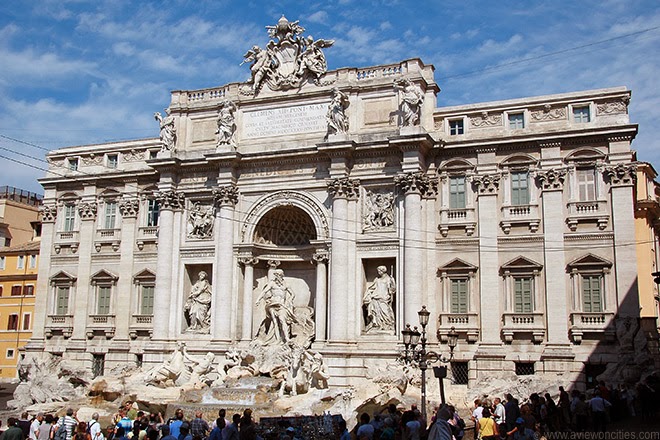
The Fontana di Trevi or Trevi Fountain is the most famous and arguably the most beautiful fountain in all of Rome. This impressive monument dominates the small Trevi Square located in the Quirinale district.

Aqua Virgo

Trevi-Fountain


Trevi-Fountain
Trevi-Fountain


Trevi-Fountain

Trevi Fountain

Trevi-Fountain-night


The Trevi Fountain is situated at the end of the Aqua Virgo, an aqueduct constructed in 19 BC by Agrippa, the son-in-law of Emperor Augustus. The aqueduct brings water all the way from the Salone Springs (approx. 21km from Rome) and supplies the fountains in the historic center of Rome with water.

According to legend, Agrippa sent out a group of soldiers to search for a spring near Rome. The spring was found after a young virgin (virgo) showed the source to the soldiers, hence the name of the aqueduct.

Construction of the Fountain

Statue-of-Neptune-Trevi-Fountain

Statue of Neptune, Trevi Fountain

Already in the fifteenth century a small Trevi Fountain was built here during the papacy of Nicholas V. In 1732, pope Clement XII commissioned Nicola Salvi to create a large fountain at the Trevi Square to replace the existing fountain. A previous undertaking to build the fountain after a design by Bernini was halted a century earlier after the death of pope Urban VIII. Salvi based his theatrical masterpiece on this design. He never saw his monumental Baroque fountain completed. The Trevi Fountain was only inaugurated in 1762, eleven years after Salvi had passed away.

The Fountain

Tritone-and-horse-Trevi-Fountain

 Tritone and horse, Trevi Fountain

Triton-and-Restive-Seahorse

Triton and Restive Seahorse

Triton-with-calm-horse

The obedient sea horse
The fountain, which is designed like a monumental triumphal arch, was built against a wall of the Palazzo Poli. It measures twenty meters wide and twenty-six meters high and occupies more than half the square.

The central figure of the fountain, standing in a large niche, is Neptune, god of the sea. He rides a shell-shaped chariot that is pulled by two sea horses. Each sea horse is guided by a Triton. One of the horses is calm and obedient, the other one restive. They symbolize the fluctuating moods of the sea. The statues were sculpted by Pietro Bracci.

On the left hand side of Neptune is a statue representing Abundance, the statue on the right represents Salubrity. Both these statues were the work of Filippo della Valle.

Above the two allegorical statues are bas-reliefs. The one on the left shows Agrippa, the general who built the aqueduct that carries water to the fountain.

He is shown explaining his plan for the aqueduct to Augustus. The bas-relief on the right captures the moment the virgin points to the source of the spring. The allegorical statues in front of the attic symbolize the four seasons. Crowning the top is the coat of arms of pope Clement XII.

Water flows over artificial rocks into a large semicircular basin that represents the sea. Every day some eighty million liters of water flow through the fountain. The water is reused to supply several other Roman fountains, including the Fountain of the Four Rivers, the Tortoise Fountain and the Fountain of the Old Boat in front of the Spanish Steps.

Tossing a Coin

Crowds-at-the-Trevi-Fountain

Crowds-at-the-Trevi-Fountain

 The crowded square

Tradition has it that you will return to Rome if you throw a coin into the fountain's water basin. You should toss it with your right hand over your left shoulder (or left hand over your right shoulder) with your back to the fountain. You're not allowed to look behind you while you're tossing the coin but the fountain is so large it's basically impossible to miss.

Sunday

Top Attractions of Paris France - Jardin du Luxembourg Luxembourg Garden

The Jardin du Luxembourg is probably the most popular park in Paris. The park, situated near the Latin Quarter, offers a lot of variety and attracts all kinds of people, from students and parents with children to tourists.
Luxembourg-Garden

Luxembourg-Garden

Jardin du Luxembourg
The 22.45 hectare large park (about 55 acres) can get pretty crowded when the sun comes out. Students come here to rehearse their courses, neighbors come here for a stroll and like with all great places in Paris, there are always plenty of tourists. But despite its popularity, the Jardin du Luxembourg is plenty enjoyable and a welcome relief from the crowded Parisian streets.

History

The park was originally owned by the duke of Luxembourg, hence the name. The domain was purchased in 1612 by Marie de' Medici, the widow of King Henry IV. After the king was murdered in 1610 she decided to move out from the Louvre to a new residence.

Marie de' Medici was of Italian descent and had spent her youth in Florence at the Pitti Palace. The Boboli garden at this palace was the inspiration for the Jardin du Luxembourg. 
 
She commissioned Salomon de Brosse with the construction of a new palace and had the garden laid out in Italian fashion. At the time the garden was quite small due to the existence of a Carthusian monastery to the south of the palace. Despite the insistence of Marie de' Medici the Carthusians refused to leave and the garden stretched no further than the current octagonal pond.

Almost two hundred years later, during the French Revolution, the Carthusians were forced to leave when revolutionaries confiscated the monastery. This paved the way for a significant expansion of the gardens and a redesign in a more French style. Baron Haussmann, during his massive urban renewal of Paris in the mid nineteenth century, nibbled at the edges of the park, but it is still one of the largest green spaces in the center of Paris.

The Park

Luxembourg-Garden

 Relaxing in the park


Orangery-Luxembourg-Garden


Orangery
In the middle of the park is a large octagonal pond, known as the Grand Bassin. Here, children can rent small boats. The Jardin du Luxembourg boasts many other attractions for children such as a puppet theater, pony rides, a merry-go-round and a large playground.

Around the pond are nice lawns, paths, and some of Paris's most beautiful flower beds, all laid out in a geometrical pattern and enclosed by a balustrade. Numerous statues adorn the park. This is also one of the parks where you can simply get hold of one of the many chairs and take it to the exact spot where you want to sit. The park is also popular with chess players and jeu de boules players. There's also a tennis court, a music pavilion and an orangery in the park. Right behind the orangery is the Musée du Luxembourg, a museum that is only open for temporary exhibitions.

Fountains

The Jardin du Luxembourg features several noteworthy fountains. The most famous one is the Fontaine Médicis, a romantic Baroque fountain designed in the early seventeenth century. 
 
Fontaine-Médicis
 
Fontaine Médicis
It is located at the end of a small pond at the northeast side of the park. A central sculpture group shows the Greek mythological figure of Polyphemus who observes the lovers Acis and Galatea. It is flanked by allegorical figures depicting the rivers Seine and Rhône.

Very few people realize that there's another fountain, the Fontaine de Léda, at the back of the Fontaine Médicis. This fountain was created in 1806. A relief shows a mythical scene with Leda and Zeus disguised as a swan. 
Fontaine-Delacroix
 
Fontaine Delacroix
 
 
There's a third fountain on the other, west side of the palace. It honors the French painter Eugène Delacroix and consists of a rectangular basin with six jets. At the center is a tall pedestal with a bust of the painter. Sensual allegorical statues of Time, Glory and Genius stretch from a plinth towards the bust.

At the southern end of the park, in an extension known as the Jardins de l'Observatoire, is yet another fountain, the Fontaine de l'Observatoire. The monumental fountain was created in 1873 by Davioud, Carpaux and Frémiet. The centerpiece of the fountain shows a globe supported by four women, each representing a continent.

Statues

Statue-of-Liberty

 La Liberté

There are almost seventy statues and monuments scattered around the park. Among them are twenty statues of French Queens, including Marie de' Medici. The patroness of Paris, Sainte-Geneviève, is another woman whose effigy you can find here. Many of the statues in the Jardin du Luxembourg honor famous (mostly French) people, from politicians and scientists over sculptors and painters to poets and composers like Chopin and Beethoven. Other statues depict animals or are inspired by mythology, such as the Dancing Faun.

Many visitors will be surprised to see La Liberté, a miniature version of the Statue of Liberty created by Auguste-Bartholdi himself. And there's also a bit of Rome in the Jardin du Luxembourg thanks to the Bocca della Verità monument, which depicts a woman who puts her hand in the Mouth of Truth.

The Palace

Palais-du-Luxembourg
Palais du Luxembourg
 
Between 1615 and 1627 the Palais du Luxembourg (Luxembourg Palace) was constructed at the northern end of the Jardin du Luxembourg.

The palace was built for Marie de' Medici, who was nostalgic about her youth at the Pitti Palace in Florence, so she asked the architect, Salomon de Brosse, to look at the Pitti Palace for inspiration, hence the Florentine style of the palace. The widowed queen did not get the time to enjoy her new palace and gardens for long as she was banished by Richelieu in 1625, before the palace was completed.

In 1794, during the French Revolution, the palace served as a prison. It also served as the headquarters of the Luftwaffe during the Second World War. The building currently houses the French Senate.

Monday

Top Attractions of Rome Piazza Navona Navona Square

Piazza Navona is one of the most famous and arguably the most beautiful of Rome's many squares. The large and lively square features no less than three magnificent fountains. Another eyecatcher is the Baroque church of Sant'Agnese in Agone.
 
Palazzo-Pamphilj-Piazza-Navona
 
Piazza-Navona
 Piazza Navona

Domitian's Stadium

Moor-Fountain

 Moor Fountain

Moor-Fountain

Moor Fountain


Domitian's-Stadium

Domitian's Stadium
 
Fountain-of-the-four-rivers
 
Fountain of the four rivers
 
 
Neptune-Fountain-Navona-Square
 
Neptune Fountain
 
The square is built on the former Stadium of Domitian, built by Emperor Domitian in 86 AD. Hence the long, oval shape of the square. The stadium, which had a larger arena than the Colosseum was mainly used for festivals and sporting events.

The stadium was known as 'Circus Agonalis' (competition arena). It is believed that over time the name changed to 'in agone' to 'navone' and eventually to 'navona'.

In the fifteenth century the stadium was paved over to create the Navona square, but remnants of Domitian's stadium are still visible around the area. Guided tours to this underground monument are available, they start at Piazza Tor Sanguigna 13.

Fountain of the Four Rivers

The main attraction of Piazza Navona is the trio of fountains that adorn the square. The central and largest fountain is the Fontana dei Quattro Fiumi (Fountain of the Four Rivers). It was constructed between 1647 and 1651 on request of pope Innocent X.

The design of the fountain was first commissioned to Borromini, but it was ultimately handed to his rival Bernini. The fountain features four figures, each representing a river from a different continent - the Nile, Ganges, Danube and Rio de la Plata. The statues are at the base of a rock supporting an obelisk, originally located at the Circus of Maxentius, near the Appian Way.

Neptune Fountain & Moor Fountain

The two other fountains on the piazza are the Fontana del Nettuno (Neptune fountain) at the northern end and the Fontana del Moro (Moor fountain) at the southern end of the square.

The Fontana del Nettuno, also known as the Calderari, was built in 1576 by Giacomo della Porta. The statues of Neptune surrounded by sea nymphs were added in the nineteenth century.

Giacomo della Porta also built the Fontana del Moro. The central statue of a Moor holding a dolphin, a design by Bernini, was added in the seventeenth century. The tritons are nineteenth-century additions.

Church of Sant'Agnese in Agone

Sant'Agnese-Agone-Piazza-Navona

 Sant'Agnese in Agone

Another highlight at Navona square is the church of Sant'Agnese in Agone. It was commissioned in 1652 by Pope Innocent X and built on the site where according to legend, St. Agnes was stripped naked, but miraculously saved from disgrace by extraordinary growth of hair.

The front facade of the Baroque church was designed by Borromini, Bernini's main rival. Construction started just two years after the completion of Bernini's Fountain of the Four Rivers, right in front of the building. The church was completed in 1670.

Location

The Piazza Navona is situated in the historic center of Rome, west of the Pantheon. It is one of Rome's liveliest squares, with many outdoor cafes, restaurants and night clubs in the neighborhood.
Related Posts Plugin for WordPress, Blogger...