Showing posts with label Rome attractions. Show all posts

Thursday

Top Attractions of Rome Vatican Museums Musei Vaticani

What started as just a small collection of sculptures has, over the centuries, turned into a complex of the world's most magnificent museums featuring one of the finest collections of art on the planet.

History of the Museums

Vatican Museums, Rome
Vatican Museums
Ceiling -detail,-Vatican-Museums
 
Ceiling-painting-Vatican-Museums
 Ceiling painting, Vatican Museums
 
Ceiling -detail,-Vatican-Museums
Ceiling detail, Vatican Museums
Gallery-of-Maps-Vatican-Museums
Gallery of Maps, Vatican Museums
 

Gallery-of-Maps
 Gallery of Maps
 
Perugia-Gallery-of-Maps-Vatican-Museums
 Perugia, Gallery of Maps, Vatican Museums
The Vatican Museums were founded under the patronage of two eighteenth-century popes - Clement XIV (1769-1774) and Pius VI (1775-1799) - who were among the first to open collections of art to the general public for viewing, therefore promoting culture among the masses. Appropriately, the first building in the museum complex, the Pio-Clementine Museum, was named after these two pontiffs.

As the decades passed, more popes added to the already impressive collection of diverse artworks owned and displayed by the Vatican. Today, there are thirteen museums in about fourteen Vatican palaces that are included on tours of the Vatican Museum complex. The building complex is worth a visit in itself as all rooms and hallways are lavishly decorated with marble and frescoes.

The Museums

Former-entrance-Vatican-Museums

 Former entrance of the Vatican Museums

Statues-on-top-of-the-former-entrance,-Vatican-Museums

 Statues on top of the former entrance, Vatican Museums

The many museums that make up the Vatican complex are quite diverse. Nonetheless, each is interesting to explore and which you enjoy most will largely depend on your artistic preferences. 

Cortile della Pigna (Pinecone courtyard)
Pine-cone-ancient-fountain-Cortile-della-Pigna
 Pine cone (ancient fountain), Cortile della Pigna


Laocoon sculpture, Vatican Museum, Rome
Laocoön
Cybele-goddess -of-fertility-Vatican-Museums
 Statue of Goddess Cybele, goddess of fertility, Vatican Museums


Antinous-Dionysus-Osiris-Vatican-Museums
 Antinous as Dionysus-Osiris, Vatican Museums


Meeting-of-Leo-the-Great-and-Attila,-Vatican-Museums
 Meeting of Leo the Great and Attila, Vatican Museums
 
The Gregorian Egyptian Museum was founded in 1839 by Pope Gregory XVI, who had a keen interest in Egypt. Featuring nine rooms, objects d'art in this museum range from stelae and hieroglyphics from around 2500 AD to Roman replicas of Egyptian statues from the second century AD. Not to miss here is the collection of mummies from around 1000 BC that were found at the Necropolis of Deir el-Bahri in Thebes. 
La-Pudicizia,-Vatican-Museums

La Pudicizia, Vatican Museums
Mummy-Vatican-Museums
Mummy in the Vatican Museums
Colossus-of-the-Nile-Vatican-Museums

Colossus of the Nile, Vatican Museums
 
  The Gregorian Etruscan Museum was founded by the same Pope. Here you'll find utensils from the pre-Roman era such as a collection of terra-cotta vases. The highlight of the collection is a series of objects found in a necropolis, among them a throne and a carriage.

The Vatican Pinacoteca, one of the newer museums - opened in 1932 - is, technically, a picture gallery. Paintings range in age from the twelfth to nineteenth centuries and include entire rooms devoted to the works of such greats as Raphael and Caravaggio. There's also a unique display of religious icons from the fifteenth to the nineteenth century.

Founded by Pius XI in 1926, the Ethnological Missionary Museum features objects of a religious nature from four geographical areas - Asia, Oceania, Africa, and America. About 80,000 pieces make up the total collection for this particular museum.

The largest collections of the Vatican Museum are those with ancient Roman and Greek art. Some of the most famous objects of art can be found in the Pio-Clementine Museum such as the famous Laocoön statue, the Apoxyomenos and the Apollo del Belvedere. Another interesting museum with Roman art is the Museo Gregoriano Profano, where you'll find a number of Roman replicas of original Greek statues.
Red-porphry-bowl-from -ero's-Domus-Aurea
 Red porphry bowl from Nero's Domus Aurea
 
Other museums include the Collection of Modern Religious Art, founded by Pope Paul VI in 1973 and featuring 55 rooms; the Pio Christian Museum (with the Christian and Hebrew Lapidary); Tapestries; Ceramics; Miniature Mosaics; Museo Sacro; Gregorian Profane Museum; and the Vatican Historical Museum, which provides a fascinating look at the long and sometimes turbulent history of the Vatican.


Sistine Chapel and Stanze of Raphael

 Ceiling-Fresco-Sistine-Chapel-Vatican-Museums

 Ceiling Fresco, Sistine Chapel, Vatican Museums
 
The-Last-Judgment-by-Michel-Angelo-Sistine-Chapel
 The Last Judgment by Michelangelo, Sistine Chapel
 
 
Sistine Chapel
Fresco-in-Stanze-di-Raffaello-Raphael's-Room
 
 Fresco in Stanze di Raffaello (Raphael's Room)


One of the highlights of the Vatican Museums is the famous Sistine Chapel, where visitors can enjoy not only Michelangelo's magnificent ceiling but also a host of other wonderful works of art, including the The Last Judgment on the altar wall, from the same artist. (Bring binoculars for a better view.)

The ceiling painting, which depicts scenes from the Old Testament, is one of the world's most famous works of art and attracts up to twenty thousand people every day.

In addition, the four rooms known as the Stanze of Raphael, once the residence of Pope Julius II, feature the works of Raphael and his assistants. The most famous fresco in these rooms is the "School of Athens", a masterwork of perspective painting.

Staircase

Staircase at the Vatican Museums
Vatican Staircase
Before exiting the museum you have the chance to admire one of the world's most famous staircases. Designed in 1932 by Giuseppe Momo, the staircase consists of a double helix, one leading up and one leading down. The beautiful bronze staircase is decorated with papal coats of arms.

Visiting the Vatican Museums

Once you've purchased your tickets for admission to the Vatican Museums, you can choose to follow one of four color-coded itineraries that range from 1.5 hours to more than 5 hours. All itineraries end in the Sistine Chapel. Even with a five-hour tour, it's impossible to see everything there is to admire, but you'll get a good overview and hit the most well-known highlights of these magnificent museums.

Friday

Top Attractions of Rome Trevi Fountain Fontana di Trevi

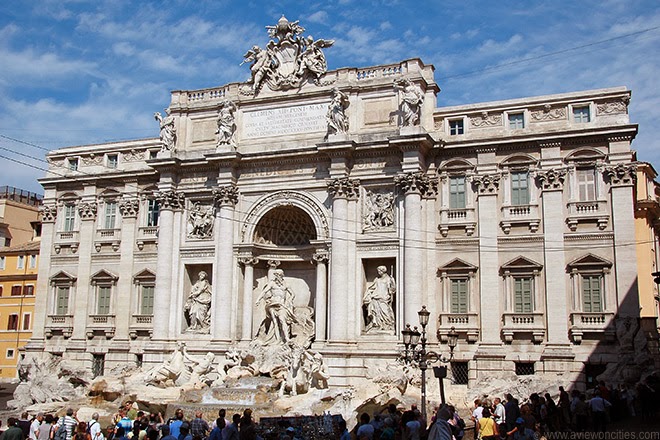
The Fontana di Trevi or Trevi Fountain is the most famous and arguably the most beautiful fountain in all of Rome. This impressive monument dominates the small Trevi Square located in the Quirinale district.

Aqua Virgo

Trevi-Fountain


Trevi-Fountain
Trevi-Fountain


Trevi-Fountain

Trevi Fountain

Trevi-Fountain-night


The Trevi Fountain is situated at the end of the Aqua Virgo, an aqueduct constructed in 19 BC by Agrippa, the son-in-law of Emperor Augustus. The aqueduct brings water all the way from the Salone Springs (approx. 21km from Rome) and supplies the fountains in the historic center of Rome with water.

According to legend, Agrippa sent out a group of soldiers to search for a spring near Rome. The spring was found after a young virgin (virgo) showed the source to the soldiers, hence the name of the aqueduct.

Construction of the Fountain

Statue-of-Neptune-Trevi-Fountain

Statue of Neptune, Trevi Fountain

Already in the fifteenth century a small Trevi Fountain was built here during the papacy of Nicholas V. In 1732, pope Clement XII commissioned Nicola Salvi to create a large fountain at the Trevi Square to replace the existing fountain. A previous undertaking to build the fountain after a design by Bernini was halted a century earlier after the death of pope Urban VIII. Salvi based his theatrical masterpiece on this design. He never saw his monumental Baroque fountain completed. The Trevi Fountain was only inaugurated in 1762, eleven years after Salvi had passed away.

The Fountain

Tritone-and-horse-Trevi-Fountain

 Tritone and horse, Trevi Fountain

Triton-and-Restive-Seahorse

Triton and Restive Seahorse

Triton-with-calm-horse

The obedient sea horse
The fountain, which is designed like a monumental triumphal arch, was built against a wall of the Palazzo Poli. It measures twenty meters wide and twenty-six meters high and occupies more than half the square.

The central figure of the fountain, standing in a large niche, is Neptune, god of the sea. He rides a shell-shaped chariot that is pulled by two sea horses. Each sea horse is guided by a Triton. One of the horses is calm and obedient, the other one restive. They symbolize the fluctuating moods of the sea. The statues were sculpted by Pietro Bracci.

On the left hand side of Neptune is a statue representing Abundance, the statue on the right represents Salubrity. Both these statues were the work of Filippo della Valle.

Above the two allegorical statues are bas-reliefs. The one on the left shows Agrippa, the general who built the aqueduct that carries water to the fountain.

He is shown explaining his plan for the aqueduct to Augustus. The bas-relief on the right captures the moment the virgin points to the source of the spring. The allegorical statues in front of the attic symbolize the four seasons. Crowning the top is the coat of arms of pope Clement XII.

Water flows over artificial rocks into a large semicircular basin that represents the sea. Every day some eighty million liters of water flow through the fountain. The water is reused to supply several other Roman fountains, including the Fountain of the Four Rivers, the Tortoise Fountain and the Fountain of the Old Boat in front of the Spanish Steps.

Tossing a Coin

Crowds-at-the-Trevi-Fountain

Crowds-at-the-Trevi-Fountain

 The crowded square

Tradition has it that you will return to Rome if you throw a coin into the fountain's water basin. You should toss it with your right hand over your left shoulder (or left hand over your right shoulder) with your back to the fountain. You're not allowed to look behind you while you're tossing the coin but the fountain is so large it's basically impossible to miss.

Sunday

Top Attractions of Rome Circus Maximus Circo Massimo

The Circus Maximus was the largest stadium in ancient Rome. Popular chariot races were held here for almost a millennium. At one point the Circus could seat 250.000 people, one quarter of Rome's population.

Early History

Circus-Maximus-Rome

 Circus Maximus Today

Chariot races were one of the Roman's most popular forms of entertainment. Romulus, the first of Rome's seven kings, is said to have held chariot races.

The origins of the Circus Maximus go back to the 6th century BC when Tarquinius Priscus, the fifth king of Rome, created a track between the Palatine and Aventine hills. The first permanent starting gates were created in 329 BC. In 174 BC the gates were rebuilt and seven wooden eggs were placed on top of the spina, the central wall in the arena. The eggs were used to count the number of laps; after each lap one egg was removed. In 33 BC seven bronze dolphins were added to the spina for the same purpose.

Wooden Structures

A fire in 31 BC, the first of three, destroyed the wooden structure. It was rebuilt by Emperor Augustus who also added an imperial box on the Palatine Hill. A large obelisk from Heliopolis was added to the spina as a decoration. The obelisk can now be found at the center of the Piazza del Popolo. Another obelisk was added much later, in the 4th century.
A second fire, in AD 64, which started in wooden shops at the bottom around the track started the fire that burned much of Rome during the reign of Emperor Nero. 
 
Scale-model-Circus-Maximus
 
Scale model of the Circus Maximus in Ancient Rome

The Marble Stadium

After yet another fire the Circus was rebuilt by Trajan in AD 103. The Roman Empire was at the height of its power and the new Circus Maximus reflected this status. The Circus was now a stone construction, three stories high. The lower part of the cavea (seating area) was built in marble. The arena complex was now more than 600m long and 150m wide (2000x500ft).

Popular Events

The Circus Maximus was occasionally used for events such as processions or gladiator combats, but on most days only chariot races with quadrigaes, pulled by four horses, were held here. The races themselves were wildly popular with people fanatically supporting one of the four factions: red, white, green and blue representing summer, winter, spring and autumn respectively. Bets were laid on one of the factions and supporters of the different factions often clashed, sometimes resulting in deaths among the spectators.

The Last Race

The last race at the Circus Maximus was held in AD 549, almost a millennium after the first races were held at this location. Today only the layout of the original circus can be seen in what is now a large grassland. Most of the original structure was used as building material for medieval and Renaissance constructions.

Friday

Top Attractions of Rome Vatican City (Città del Vaticano)

The world's smallest country, Vatican City occupies 0.44 sq km (about .2 square miles) and is completely encircled by the city of Rome. Vatican City serves as the spiritual center for millions of practicing Roman Catholics worldwide.


But Vatican City is also a tourist magnet thanks to the presence of some of Rome's most popular attractions, including the St. Peter's Basilica and the Vatican Museums, home to the Sistine Chapel. 
Cortile-del-Belvedere-Vatican-Museums


Usually referred to as a City State and often called "The Holy See", Vatican City is home to about 800 residents. None of them are permanent. The population of this tiny area, which surrounds St. Peter's Basilica, is made up of priests, nuns, guards, high-ranking dignitaries and, of course, the pope, and is constantly changing.


History of Vatican City


Vatican City wasn't always this small. In the mid-19th century, the Papal States covered approximately 44,000 square km (17,000 sq mi). However, during the next decade and the struggle for Italian unification, the majority of these states officially became a part of the country of Italy.

The pope's power was abolished and the papal territory was confined to the Vatican. In 1929, the Treaty of Lateran gave The Holy See autonomy, officially establishing this tiny area that attracts millions of visitors each year. The city state is protected by its own military, the strangely-clad Swiss Guards.
St.-Peter's-Basilica-and-St.-Peter's-Square


St. Peter's Square

St.-Peter's-Square
St.-Peter's-Square


St. Peter's Square

Guests enter Vatican City through expansive St. Peter's Square. The square was laid out by Bernini during the pontificates of Alexander VII and of Clement IX (1657-1667). Visitors to this magnificent square (which is actually an ellipse) are surrounded by two huge colonnades, with 284 Doric columns arranged in 4 rows, atop which stand 140 statues of saints.

In the center of the square, you'll find a 25.31-meter-tall (83 ft) Egyptian obelisk, brought to Rome by Caligula in 38 AD from Heliopolis, located on the Nile Delta. Fountains are situated on either side of the obelisk. The one sitting on the right was placed in this location by Bernini and was made by Carlo Maderno. The other was created by Carlo Fontana.

Thousands of guests gather in the square to hear blessings from the pope or to participate in masses, especially on religious holidays such as Christmas and Easter.


St. Peter's Basilica

St.-Peter's-Basilica


St. Peter's Basilica


St. Peter's Basilica, the crowning glory of Vatican City, is the most important church in the world. The cornerstone of this church was laid more than 500 years ago, in 1506. The magnificent altars and monuments inside the church are too numerous to mention, but even those who aren't art aficionados will be wowed by what they'll find inside this amazing basilica, including more works by the renowned sculptor/architect Gian Lorenzo Bernini and also Michelangelo's Pietà.

The enormous dome of St. Peter's is accessed from an elevator to the roof. Once you've reached the top of the elevator, 323 additional steps take you to the best view of Rome from anywhere in the city.

Swiss-Guard-Vatican-City
 Swiss Guard

The Swiss Guards


Near the entrance of the basilica you will probably encounter some of the famous Swiss Guards. Since 1506 when pope Julius II invited Helvetian soldiers to join the small Vatican army, they have been the guards of the Vatican and the pope in particular. All entrants to the army must be Swiss, Catholic and they must take the oath of loyalty to the pope. This oath is taken May 26th, to commemorate the sacking of Rome on the same day in 1527 when Swiss guards protected pope Clement VII during his escape to Castel Sant'Angelo. Of the 189 guards, only 42 survived.


Vatican Museums

Pinecone-Vatican-City


Pinecone-Vatican-City

 Pinecone courtyard

Governorate-Palace-Vatican-City

Governorate Palace

Vatican City is also home to the expansive Vatican Museums, which boasts one of the most impressive art collections in the world. Some of the most famous works of art on display here include the wall and ceiling paintings of the Sistine Chapel, the Stanze of Raphael, the Lacoön statue and the Apollo del Belvedere. A tour of the museums is a must for any visitor to Rome.


Finding Your Way Around


Vatican City is an amazing place, so you'll want to be sure you don't miss a thing. The Vatican has its own tourist office on the left side of the piazza which is a good place to begin your visit. Here you can book tours of Vatican City's gardens and purchase maps and other guide books for self-guided tours of the square, basilica, and museums.


By the way, rumor has it that the Vatican's postal system is better than that of the city of Rome, so be sure to mail your postcards there! 
Scale-model-of-Vatican-City-in-the-Vatican-Museums

Scale Model of Vatican City

Monday

Top Attractions Of Rome The Colosseum

The Colosseum is probably the most impressive building of the Roman Empire. Originally known as the Flavian Amphitheater, it was the largest building of the era.

The monumental structure has fallen into ruin, but even today it is an imposing and beautiful sight.


the Colosseum in Rome
The Colosseum

The Flavian Amphitheater


Emperor Vespasian, founder of the Flavian Dynasty, started construction of the Colosseum in 72 AD. It was completed in 80 AD, the year after Vespasian's death.
The huge amphitheater was built on the site of an artificial lake, part of Nero's huge park in the center of Rome which also included the Golden House (Domus Aurea) and the nearby Colossus statue. This giant statue of Nero gave the building its current name.


The Building


Scale model of the Colosseum in the Museo della Civilta Romana
The Colosseum in Imperial Rome

Underground passageways of the Colosseum
The elliptical building is immense, measuring 188m by 156m and reaching a height of more than 48 meters (159 ft). The magnificent structure was clad in marble and 160 larger-than-life statues graced the arches on the upper floors.

The Colosseum could accommodate some 55,000 spectators who entered the building through no less than 80 entrances. Above the ground are four stories, the upper story contained seating for lower classes and women. 


Colosseum in Rome
Colosseum in Rome
The Colosseum today

Colosseum seen from Colle Oppio


The lowest story was preserved for prominent citizens. Below the ground were rooms with mechanical devices and cages containing wild animals. The cages could be hoisted, enabling the animals to appear in the middle of the arena.


Velarium


The Colosseum was covered with an enormous awning known as the velarium. This protected the spectators from the sun. It was attached to large poles on top of the Colosseum and anchored to the ground by large ropes. A team of some 1,000 men was used to install the awning.


Bread and circuses


Emperors used the Colosseum to entertain the public with free games. Those games were a symbol of prestige and power and they were a way for an emperor to increase his popularity.


Inside the Colosseum in Rome
Inside the Colosseum
Games were held for a whole day or even several days in a row. They usually started with comical acts and displays of exotic animals and ended with fights to the death between animals and gladiators or between gladiators. These fighters were usually slaves, prisoners of war or condemned criminals. Sometimes free Romans and even emperors took part in the action.


The Colosseum at night

Colosseum at night

Colosseum at night
Night view of
the Colosseum

Inauguration


Hundred-day games were held by Titus, Vespasian's successor, to mark the inauguration of the building in 80 AD. In the process, some 9,000 wild animals were slaughtered.


The Ruins


The southern side of the Colosseum was felled by an earthquake in 847. Parts of the building - including the marble cladding - were later used for the construction of other landmark buildings such as the St. Peter's Basilica and Palazzo Farnese.
Related Posts Plugin for WordPress, Blogger...