Thursday

Top Attractions of Berlin, Germany, Reichstag

The Reichstag, the seat of the German Parliament, is one of Berlin's most historic landmarks. It is close to the Brandenburger Gate and before the unification, it was located right next to the Berlin Wall.
Construction
Reichstag-Berlin

Reichstag

Reichstag-Berlin-twilight
Reichstag at twilight

View-of-the-Reichstag-from-the-river-Spree

View of the Reichstag from the river Spree


Front-view-the-Reichstag-Building

Front view of the Reichstag Building

Pediment-Reichstag
Pediment, Reichstag

After the founding of the German Empire in 1872, there was a need for a large parliamentary building in Berlin. It would take another ten years before there was an agreement on the design. A competition was held and out of 183 submissions, a design by Paul Wallot was chosen. The German architect created an imposing neo-Renaissance building, 137m long and 97m wide (450 x 318 ft).

The building was constructed between 1884 and 1894, mainly funded with wartime reparation money from France, a result of Prussia's defeat of France in 1871. The famous inscription 'Dem Deutschen Volke' (To the German People) was added later, in 1916, by emperor Wilhelm II. The bronze letters were cast from seized French cannons.
Reichstag-Dome

Reichstag Dome
Historic Symbol
In 1933 fire broke out in the building, destroying much of the Reichstag. It is to date still unclear who started the fire, but the Communists were blamed. It gave a boost to Hitler's Party, the NSDAP, who would soon come to power.

The building was damaged even more at the end of the war, when the Soviets entered Berlin. The picture of a Red Army Soldier raising the Soviet flag on the Reichstag is one of the most famous 20th century images and symbolized Germany's defeat.


Glass dome

View-inside-from-the-top-of-the-dome-Reichstag

View inside from the top of the dome of the Reichstag

Inside-the-Reichstag-Dome
 Inside the Reichstag Dome
The-spiraling-walkways-the-dome-of-the-Reichstag
 The spiraling walkways in the dome of the Reichstag
 Oculus-of-the-Reichstag-Dome
 Oculus of the Reichstag Dome
After the war, the Reichstag ended up in West Berlin, right near the Berlin Wall. It was reconstructed between 1958 and 1972 but the central dome and most of the ornamentation were removed. During Berlin's division the West German parliament assembled here once a year as a way to indicate that Bonn was only a temporary capital. After the unification the decision was soon made to move the Bundestag (Germany's Parliament) from Bonn to Berlin.
This decision resulted in a renovation which started in 1995 and was completed in 1999.

The design by Sir Norman Foster added a glass dome over the plenary hall. At first the subject of much controversy, the dome has become one of the city's most recognized landmarks.
Since April 1999, the Reichstag is once again the seat of the Bundestag. A part of the Reichstag is open to the public. An elevator brings you to the building's roof and you can even walk all the way to the top of the dome via a spiral walkway.

Friday

Top Attractions of Rome Trevi Fountain Fontana di Trevi

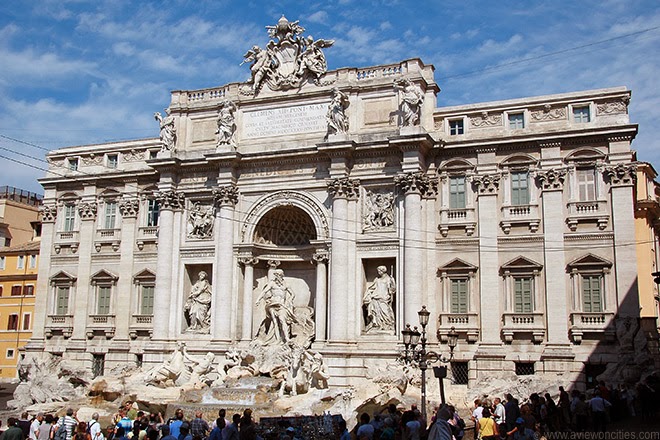
The Fontana di Trevi or Trevi Fountain is the most famous and arguably the most beautiful fountain in all of Rome. This impressive monument dominates the small Trevi Square located in the Quirinale district.

Aqua Virgo

Trevi-Fountain


Trevi-Fountain
Trevi-Fountain


Trevi-Fountain

Trevi Fountain

Trevi-Fountain-night


The Trevi Fountain is situated at the end of the Aqua Virgo, an aqueduct constructed in 19 BC by Agrippa, the son-in-law of Emperor Augustus. The aqueduct brings water all the way from the Salone Springs (approx. 21km from Rome) and supplies the fountains in the historic center of Rome with water.

According to legend, Agrippa sent out a group of soldiers to search for a spring near Rome. The spring was found after a young virgin (virgo) showed the source to the soldiers, hence the name of the aqueduct.

Construction of the Fountain

Statue-of-Neptune-Trevi-Fountain

Statue of Neptune, Trevi Fountain

Already in the fifteenth century a small Trevi Fountain was built here during the papacy of Nicholas V. In 1732, pope Clement XII commissioned Nicola Salvi to create a large fountain at the Trevi Square to replace the existing fountain. A previous undertaking to build the fountain after a design by Bernini was halted a century earlier after the death of pope Urban VIII. Salvi based his theatrical masterpiece on this design. He never saw his monumental Baroque fountain completed. The Trevi Fountain was only inaugurated in 1762, eleven years after Salvi had passed away.

The Fountain

Tritone-and-horse-Trevi-Fountain

 Tritone and horse, Trevi Fountain

Triton-and-Restive-Seahorse

Triton and Restive Seahorse

Triton-with-calm-horse

The obedient sea horse
The fountain, which is designed like a monumental triumphal arch, was built against a wall of the Palazzo Poli. It measures twenty meters wide and twenty-six meters high and occupies more than half the square.

The central figure of the fountain, standing in a large niche, is Neptune, god of the sea. He rides a shell-shaped chariot that is pulled by two sea horses. Each sea horse is guided by a Triton. One of the horses is calm and obedient, the other one restive. They symbolize the fluctuating moods of the sea. The statues were sculpted by Pietro Bracci.

On the left hand side of Neptune is a statue representing Abundance, the statue on the right represents Salubrity. Both these statues were the work of Filippo della Valle.

Above the two allegorical statues are bas-reliefs. The one on the left shows Agrippa, the general who built the aqueduct that carries water to the fountain.

He is shown explaining his plan for the aqueduct to Augustus. The bas-relief on the right captures the moment the virgin points to the source of the spring. The allegorical statues in front of the attic symbolize the four seasons. Crowning the top is the coat of arms of pope Clement XII.

Water flows over artificial rocks into a large semicircular basin that represents the sea. Every day some eighty million liters of water flow through the fountain. The water is reused to supply several other Roman fountains, including the Fountain of the Four Rivers, the Tortoise Fountain and the Fountain of the Old Boat in front of the Spanish Steps.

Tossing a Coin

Crowds-at-the-Trevi-Fountain

Crowds-at-the-Trevi-Fountain

 The crowded square

Tradition has it that you will return to Rome if you throw a coin into the fountain's water basin. You should toss it with your right hand over your left shoulder (or left hand over your right shoulder) with your back to the fountain. You're not allowed to look behind you while you're tossing the coin but the fountain is so large it's basically impossible to miss.
Related Posts Plugin for WordPress, Blogger...